Angels & Demons
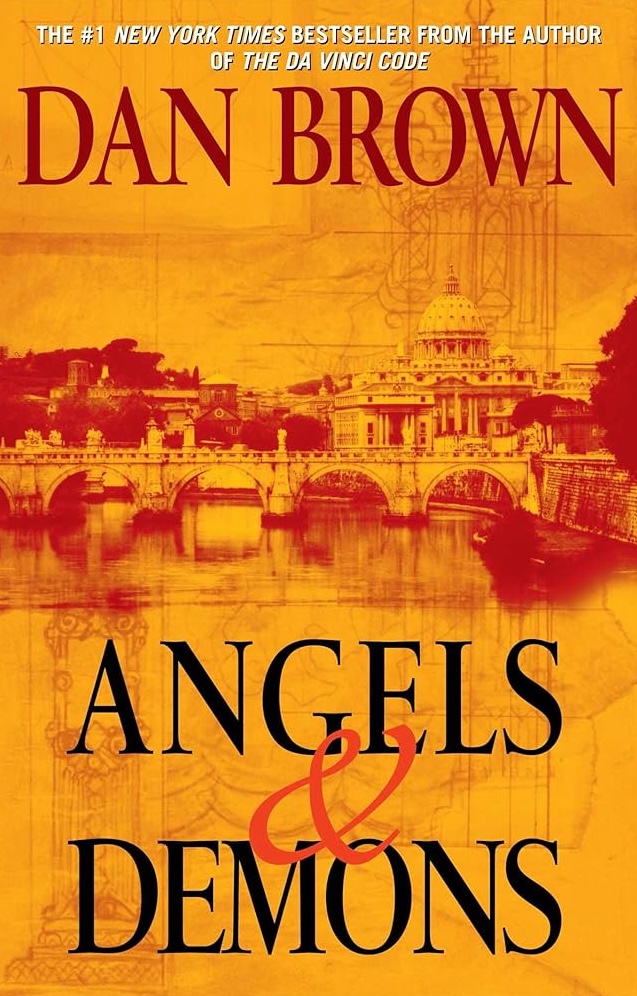
Angels & Demons by Dan Brown is the novel that introduces Robert Langdon and opens a narrative universe where mystery is inseparable from art, history, and the enduring tension between science and faith. Far from being a simple thriller, the book constructs a world in which symbols, architecture, and cultural memory become active forces, shaping the story as much as the characters themselves.
The novel is set between CERN and Vatican City, unfolding during the dramatic hours of a papal conclave. This setting is not incidental: it allows Brown to stage a confrontation between two institutions that represent humanity’s most ambitious pursuits—scientific progress and spiritual authority. Antimatter, presented as both scientific breakthrough and existential threat, functions as a powerful symbol of knowledge itself: capable of illumination, yet equally capable of destruction when stripped of ethical reflection.
Rome emerges as a central character in the story. Through Langdon’s journey, churches, sculptures, and forgotten corners of the city are transformed into a symbolic map, where Bernini’s art and hidden inscriptions form the so-called “Path of Illumination.” Art is not decorative here; it is language. Brown invites the reader to see cultural heritage as a coded system, one that preserves centuries of conflict, belief, and human aspiration beneath its surface.
Robert Langdon, introduced in this novel, is defined less by physical action than by interpretation. His role is to read the world—its symbols, its history, its silences—and in doing so, to reveal how power often hides behind culture and tradition. This intellectual approach to suspense is what distinguishes Angels & Demons from more conventional thrillers: tension is generated not only by time constraints and danger, but by the act of understanding itself.
The story reached an even broader audience with the 2009 film adaptation, Angels & Demons, directed by Ron Howard. Tom Hanks delivers a remarkably compelling interpretation of Robert Langdon, bringing credibility, restraint, and quiet authority to a character whose strength lies in thought rather than force. His performance gives depth to Langdon’s intellectual curiosity and moral seriousness, grounding the spectacle of the film in a believable human presence.
As the opening chapter of a saga, Angels & Demons establishes a dimension in which mystery becomes a gateway to culture. It was precisely this combination—mystery intertwined with art and sustained suspense—that made the Robert Langdon novels resonate so deeply with me. These stories showed how fiction can make history feel urgent, how symbols can generate narrative tension, and how cultural knowledge can be transformed into an immersive experience. In Angels & Demons, art and history are not passive backdrops but engines of meaning, reminding us that the most powerful mysteries are those that challenge how we understand truth, authority, and human values.