Inferno
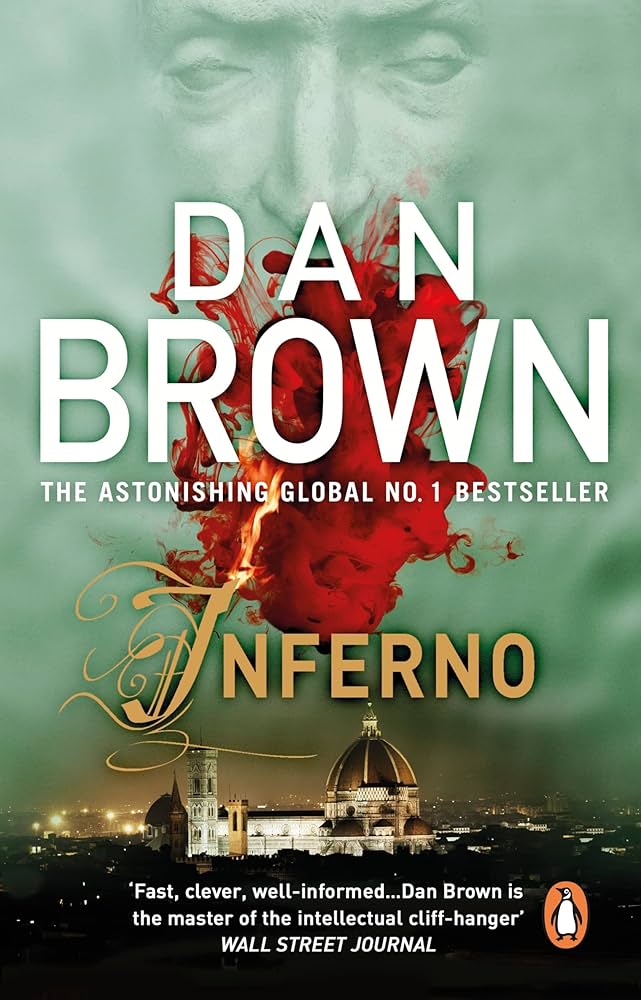
Inferno by Dan Brown represents a darker and more unsettling chapter in the Robert Langdon series, shifting the focus from secret societies and religious conspiracies to a deeply contemporary moral dilemma: the future of humanity itself. Inspired by Dante’s Divine Comedy, the novel uses classical literature as a lens through which modern fears—overpopulation, environmental collapse, and ethical responsibility—are examined with increasing urgency.
The story unfolds across Florence, Venice, and Istanbul, cities that once again act not merely as settings but as repositories of symbolic meaning. Florence, in particular, stands at the center of the narrative, where Renaissance art, architecture, and Dante’s legacy intertwine to form a puzzle that is as intellectual as it is existential. Brown transforms Dante’s Inferno into a modern moral framework, where hell is no longer a metaphysical destination, but a potential future shaped by human inaction.
Robert Langdon awakens disoriented, suffering from memory loss—a narrative choice that mirrors the novel’s thematic core. Knowledge, usually Langdon’s strongest asset, becomes fragmented, forcing both character and reader to confront uncertainty. This stylistic decision heightens tension while reinforcing the idea that understanding the present requires confronting uncomfortable truths rather than relying on familiar certainties.
At the heart of the novel lies a provocative antagonist whose motivations blur the line between villainy and moral extremism. Unlike previous adversaries, this figure is driven by a radical interpretation of scientific ethics, challenging the reader to question whether morally troubling actions can ever be justified by catastrophic predictions. Brown does not offer easy answers; instead, he invites reflection on responsibility, progress, and the cost of avoiding difficult decisions.
The cinematic adaptation, Inferno, directed by Ron Howard, brings these themes to the screen with a somber, introspective tone. Once again, Tom Hanks delivers a compelling portrayal of Robert Langdon, capturing the character’s intellectual gravity and moral restraint. His performance reinforces Langdon’s role not as an action hero, but as a mediator between culture, reason, and ethical responsibility.
Inferno deepened my appreciation for the Robert Langdon novels precisely because it dares to move beyond the comfort of pure mystery. By weaving art, literature, science, and moral philosophy into a single narrative thread, the novel transforms suspense into a space for reflection. It is this fusion—where symbols illuminate ethical tension and culture becomes a vehicle for questioning humanity’s future—that continues to make these stories resonate long after the final page.