Origin
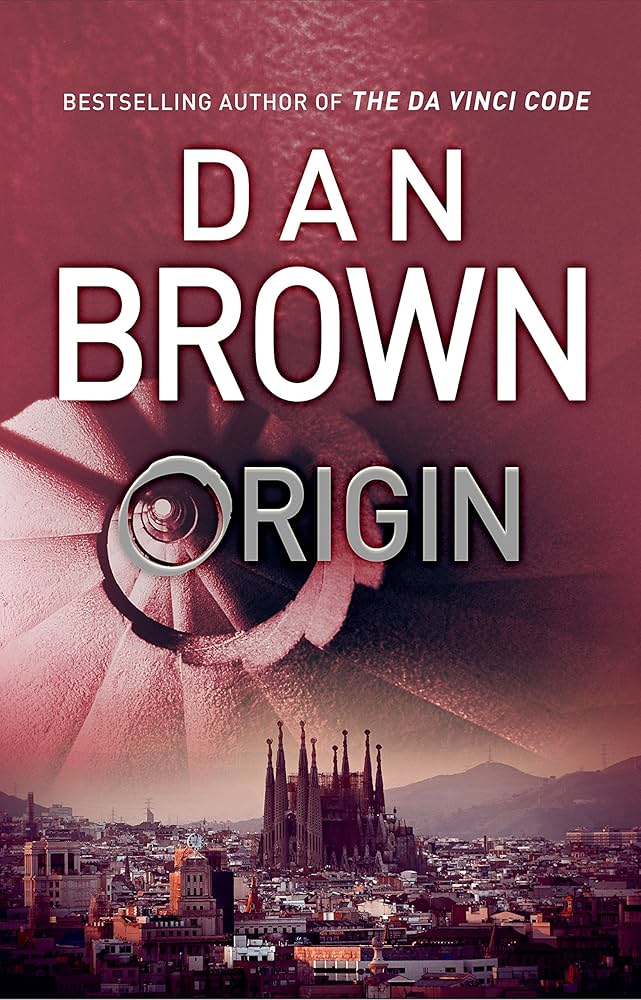
Origin by Dan Brown is perhaps the most provocative and unsettling installment in the Robert Langdon series. Where previous novels balance mystery, history, and moral reflection, Origin confronts humanity with questions that feel immediate, uncomfortable, and deeply existential: the origins of life, the destiny of humanity, and the ethical consequences of technological advancement.
Set in Spain, primarily in Bilbao and Barcelona, the novel draws on architecture, contemporary art, and scientific innovation to build a world where knowledge itself becomes both a tool and a threat. Langdon navigates museums, cathedrals, and the Guggenheim’s modernist spaces, decoding a trail of symbols left by a visionary futurist whose discoveries challenge both science and faith.
The novel’s tension is amplified by the audacity of its central theme: confronting fundamental beliefs with the inevitability of change. Unlike earlier entries, where danger is external and tangible, here the peril is conceptual and existential. This is what makes Origin unsettling: it forces the reader to grapple with ideas that question the meaning of life and the frameworks we rely upon to define it.
Robert Langdon remains a figure of intellectual curiosity and moral steadiness, but in this novel he is confronted with moral dilemmas that are broader and more ambiguous than ever before. The antagonist, while still plotting in classic thriller fashion, becomes a foil to Langdon’s own reflections on ethics, responsibility, and the intersection of progress and conscience.
Origin is the Robert Langdon novel that left me with the strongest sense of inquietude. It is not just suspense that lingers after reading, but a persistent questioning: what are the ethical limits of discovery? How do art, science, and faith interact in shaping our understanding of existence? Brown’s skill is in transforming thriller conventions into a platform for reflection, and with Origin, that reflection is sharper, more urgent, and more provocative than ever.
The ethical dilemmas in the novel extend far beyond the immediate plot. The vision of a future shaped by technological innovation raises profound questions about agency, consent, and responsibility: when knowledge has the power to alter humanity’s trajectory, who decides how it should be used—or if it should be released at all? Through this lens, every artifact, every code, every puzzle becomes more than a plot device: it is a moral question.
Langdon’s journey highlights the tension between curiosity and accountability, illustrating how intellectual pursuit can clash with ethical restraint. The antagonist embodies a radical vision of utilitarian ethics, willing to take extreme measures for what is perceived as the greater good, forcing both Langdon and the reader to confront uncomfortable questions: can ends ever justify means? Where does ambition cross into moral hubris?
In the end, Origin lingers because it challenges not only the characters within its pages but also the reader. It asks us to consider our own responsibilities in a world where scientific advancement accelerates faster than our collective reflection. Brown’s thriller becomes a mirror, prompting introspection about the values we hold, the choices we make, and the consequences that unfold when human ingenuity outpaces ethical deliberation. The novel reminds us that the most compelling mysteries are not simply about what is hidden in codes or symbols, but about the ethical and existential questions we might not yet be ready—or willing—to face.